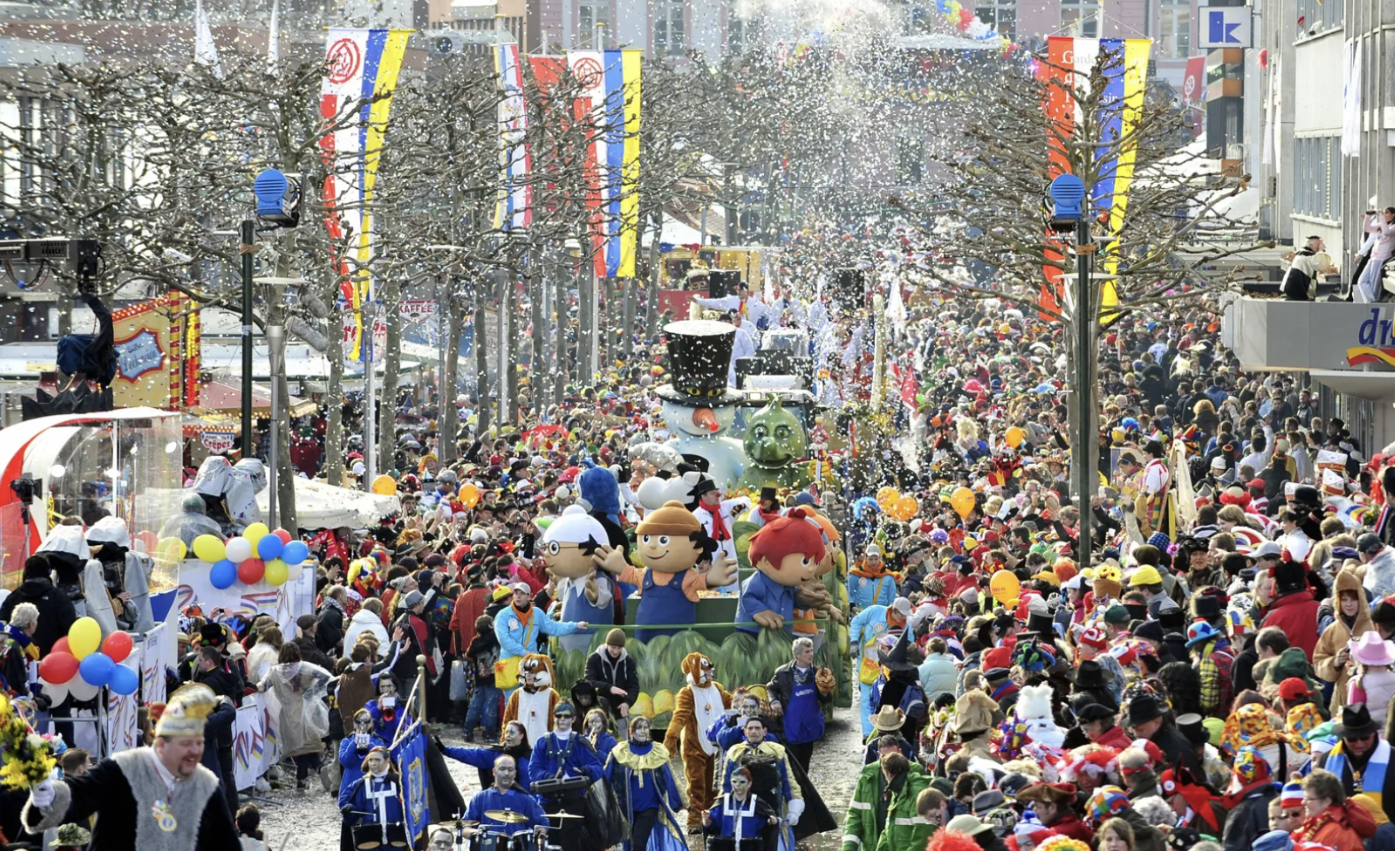

Every year in the weeks before Lent, Germany transforms into a country of parades, costumes, music and satire. Although many people outside Germany simply call it “German carnival,” there are important regional differences. In the western part, especially along the Rhine river, the celebration is called “Karneval.” In Eastern and Southwestern Germany it is known as Fastnacht or Fasching. Both traditions share the same historical roots and cultural meaning though.
The main celebration takes place in February or early March, just before the Christian season of Lent. Lent is a 40-day period fasting and reflecting before Easter. Carnival developed as a final time of joy and indulgence before this serious religious season.
In western cities, especially cities like Cologne, Dusseldorf and Mainz, karneval is a huge public event. The highlight is “Rosenmontag” (Rose Monday), when large parades move through the streets. Marching bands and dance groups entertain thousands of spectators. Many floats make fun of political leaders and current events. Political satire is a big part of Karneval. Even serious topics are presented with humor and creativity.
Another important tradition in the west is the “Dreigestirn” (Triumvirate), which represents the farmer, the prince, and the virgin. These symbolic figures lead the celebration in cities like Cologne. Participants greet each other with local carnival cries such as “Alaaf!” in Cologne or “Helau!” in Dusseldorf and Mainz. During this time, normal social rules are relaxed. People of all ages wear costumes, from superheroes to historical figures, and strangers celebrate together in the streets.
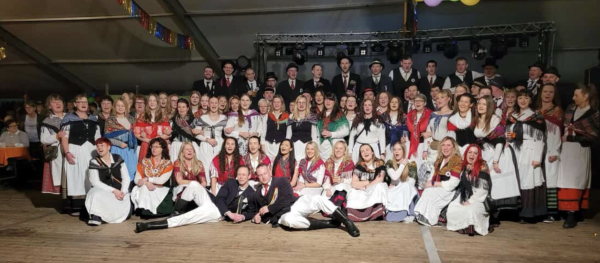
In contrast, Fastnacht in parts of Eastern and Southwestern Germany has a slightly different character. Cities such as Dresden and Leipzig have their own tradition. Fastnacht often focuses more on old traditions and local history. In many villages in Eastern Germany, Fastnacht is strongly connected to local community life. On certain days, groups of young people and members of carnival clubs walk from house to house in the village. Many participants wear traditional costumes that have been used for generations and then they start knocking on doors, sing traditional songs, tell humorous verses, or perform short sketches. In return they receive food, drinks, or small amounts of money. This custom is not meant at begging, but as a friendly exchange that strengthens the neighborhood ties and keeps old tradition alive. The collected money is often used to help finance the evening celebration. Later that evening, the entire village gathers in a large party tent. There, a DJ or a live band plays music, and people of all generations come together to laugh, dance and celebrate until late at night. The mix of traditional daytime customs and nighttime party activities, creates a fun time for all ages.
For many Germans, these traditions are an important part of cultural identity. They connect modern society with historical customs and religious roots. Whether it’s the loud political Karvenal in the west or the more traditional Fastnach in the east, Germany’s carnival season shows how regional diversity can exist within national culture.

![Gas prices being displayed at a Shell gas station as an airplane approaches San Diego International Airport for a landing on April 24.
[Source: Kevin Carter/Getty Images]](https://mbspyglass.org/wp-content/uploads/2026/05/RabadonJet-Fuel-1.png)