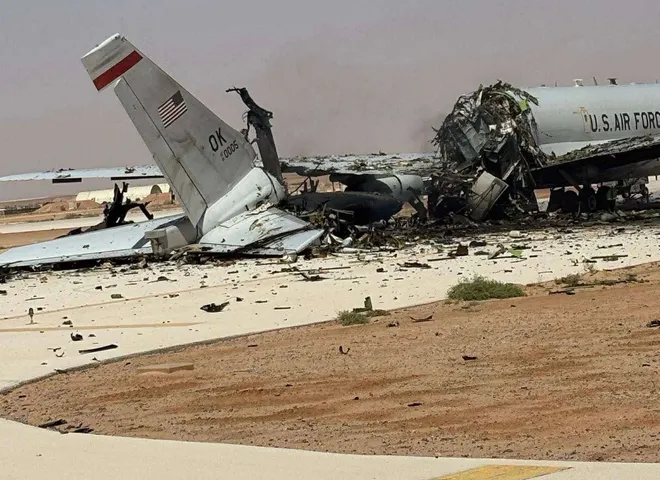
On Friday, March 27, 2026, an Iranian missile and drone attack struck Prince Sultan Air Base in Saudi Arabia, where U.S. forces were stationed. Officials reported that about a dozen American troops were wounded, some seriously, and that significant damage to various U.S. military assets, including refueling tankers and aircraft, was sustained. There were no confirmed American fatalities from this specific event; a U.S. soldier had previously died from wounds sustained in a prior attack on March 1. By March 29, satellite and drone photos circulating online claimed to reveal the most significant loss in particular from the attack, a Boeing E-3 Sentry AWACS (Airborne Warning and Control System) aircraft worth over $500 million, which was shown with a burned-out rear and a collapsed dome. U.S. military spokesmen declined to confirm the aircraft’s fate immediately, but confirmed that “several” KC-135 refueling planes were damaged. Iranian state media reported that Iran’s Revolutionary Guard Corps (IRGC) forces claimed to have “completely destroyed” the E-3 in the operation. Analysts have agreed that the E-3 likely cannot fly again.
The E-3, a large Boeing 707-based aircraft designed for surveillance and command and control purposes, acts as a massive flying radar station that detects and tracks planes and missiles, and helps with battle management. It is easily recognizable because of the huge 30-foot rotating radar dome on top of its fuselage. These planes usually carry a crew of over 20 people and serve as the military’s “eyes in the sky.” The radar is able to see threats, like low-flying drones or high-altitude missiles, from over 250 miles away. Losing one of them is a major setback because it reduces the military’s ability to spot incoming attacks and protect allied forces in the region.
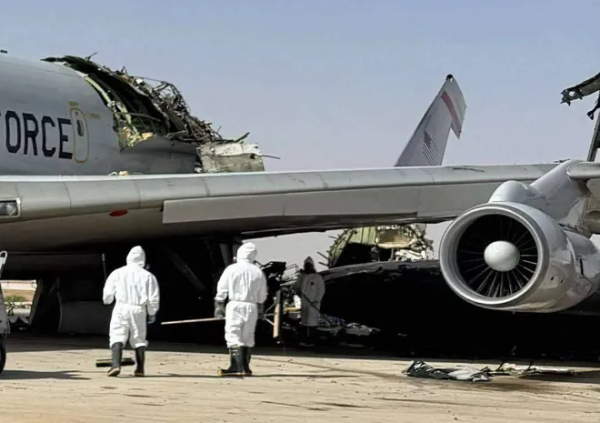
The incident shows the high-stakes nature of the conflict between the US and Iran, with the aircraft’s loss reducing U.S. air surveillance capacity in the area. Analysts say that Iran has targeted many key radar and communication assets, and taking out an E-3 could render U.S. and allied forces unable to see incoming drones or missiles. In response, American commanders are likely launching remaining AWACS, ramping up air patrols, and speeding up the replacement of damaged assets.
The attack has worsened tensions in an already tense region, sparking controversial reactions globally. Domestically, the Pentagon has focused on taking care of the wounded, while Secretary of War Pete Hegseth and Chairman of the Joint Chiefs of Staff Gen. Dan Caine stated they are assessing their military options; as a precaution, the Pentagon has announced that it is deploying roughly 6,000 additional troops to the Middle East, including an Army 82nd Airborne brigade and some Marine units. In Saudi Arabia, Saudi leaders strongly condemned the strikes, with the Foreign Ministry calling them “blatant and cowardly.” The Saudi government warned of serious consequences if the attacks continue, with the Saudi cabinet vowing to “defend the Kingdom’s security” by all means if Iran persists. The Saudi Crown Prince said that continued Iranian attacks on countries in the Gulf would lead to even more regional escalation.
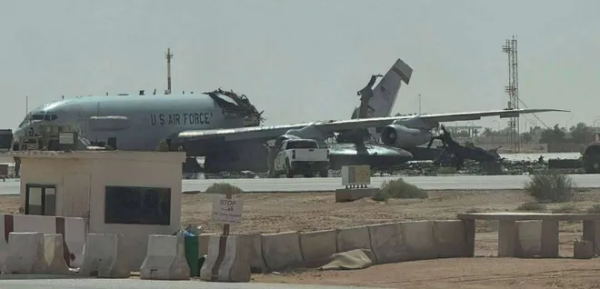
Iran publicly claimed responsibility, with a spokesman for the Iranian military releasing video footage claiming that at least one tanker was destroyed in the strike. Iranian leaders framed the attacks as retaliation for U.S. and Israeli strikes inside Iran, including the Feb. 28 killing of Iran’s Supreme Leader Ali Khamenei. Iran did not report any casualties from the operation. Internationally, many G7 foreign ministers from the UK, US, Italy, France, Germany, and Canada also condemned the violence, calling for the immediate stopping of the strikes and reminding people that the attacks on civilians and infrastructure violated international law.
Looking ahead, military experts and ethicists are continuing to watch the situation very closely. While striking a military base hosting foreign military forces is usually considered legal in an armed conflict, the loss of the E-3 and the cycle of retaliation raise concerns about the war in Iran expanding. For now, world leaders are continuing to urge diplomatic solutions to stop the violence before it escalates into a larger conflict.
Sources: Reuters, Spectrum Local News, Xinhua News Agency, Asharq al-Awsat, AP News, TWZ, Al Jazeera, Air & Space Forces Magazine, Iran Watch, The Jerusalem Post, Times of Israel, U.S. Air Force official website.


![Gas prices being displayed at a Shell gas station as an airplane approaches San Diego International Airport for a landing on April 24.
[Source: Kevin Carter/Getty Images]](https://mbspyglass.org/wp-content/uploads/2026/05/RabadonJet-Fuel-1.png)